Titans of My Childhood · Season 01 — Titans of My Childhood
Chapter 1
Titans of My Childhood, Chapter 1: The Margolis Family
Titans of My Childhood, Chapter 1: The Margolis Family — The Story Behind Olivine
Listen to this article
Read aloud by your device · 6 min read
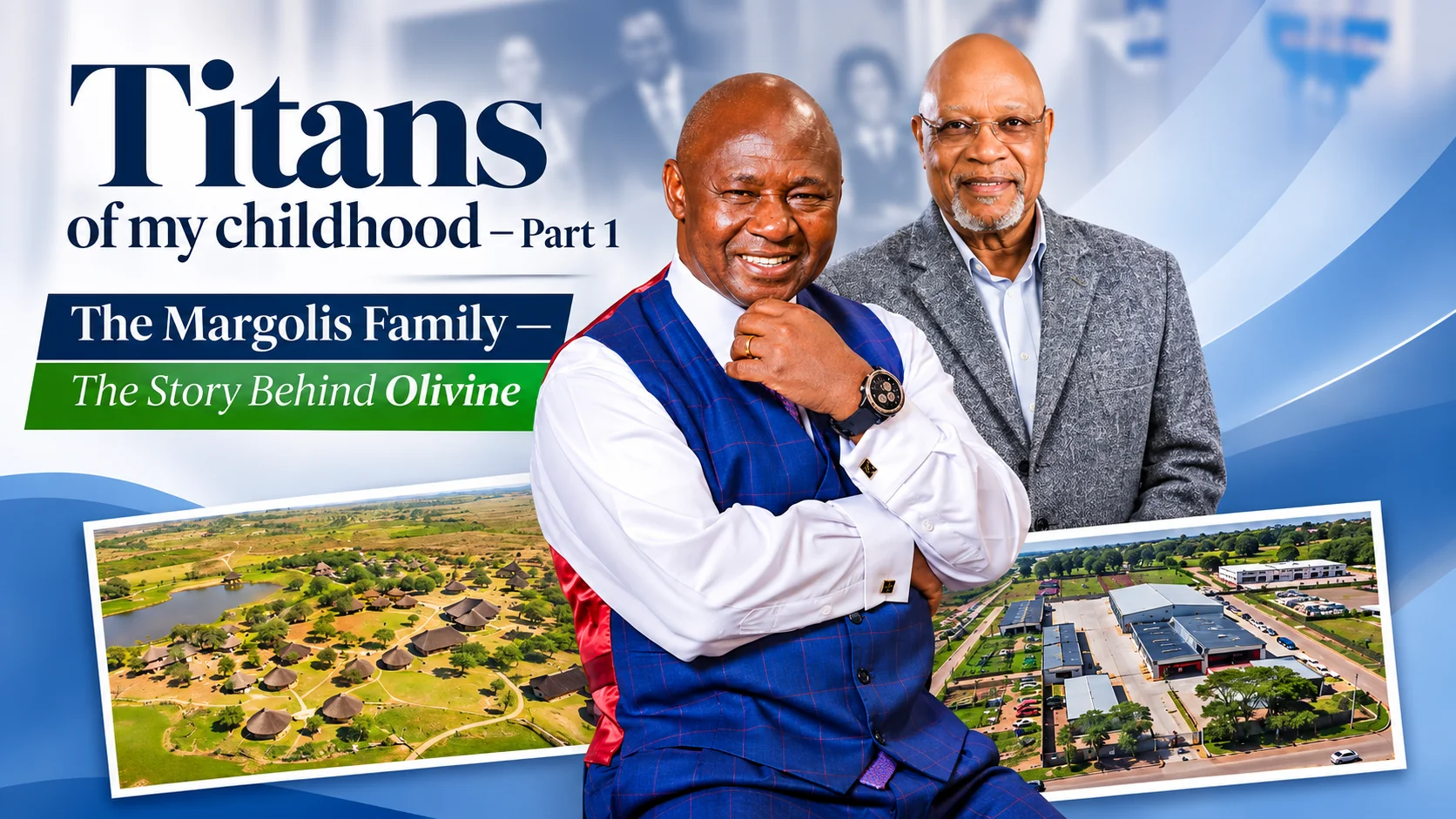
Mention the surname Margolis to many Zimbabweans and one name quickly comes to mind: Stephen Margolis.
Stephen is the man behind Margolis Plaza, Margolis Shopping Complex, the impressive 70-acre Stephen Margolis Resort in Harare, and various pieces of land in Harare, Nyanga and Victoria Falls. He has certainly carved out a name of his own. But that, as they say, is a story for another day.
Both Steve and his father were born near Musami, and he attended Musami Mission — a deep and personal connection to the area where his family first put down roots. Stephen is a third-generation member of the remarkable Margolis family, a family whose story is woven into the history of Zimbabwean business and, quite literally, into the kitchens of generations of Zimbabweans.
Behind the familiar name Olivine stands the Margolis family. The surname Margolis is derived from the Hebrew word Margalith, meaning pearl. Stephen means Crown — hence his Crown Pearl development in Nyanga, bringing the two meanings together. The family originated in Kovna, Lithuania, where nine children were born between 1875 and 1898. Three brothers — Harry, Salman and Berel — eventually found their way to Rhodesia, now Zimbabwe.
But what many people may not know is that the Margolis footprint was not confined to Harare industry. It reached into Nyazura too — the place where I grew up.
And that is where this story becomes personal for me.
In telling my own story, I often speak about my uncle, Tongai Mataranyika, and his development as a businessman in our small hometown. His growing entrepreneurship — first through transport work and side hustles, and eventually through organised retail — can be traced back, in part, to a grocery shop near Maworesa Shopping Centre that was sold to him in 1979 by his cousin, Matthew Chabarwachii Mataranyika.
But there was some history to that little convenience store.
Back in the day, there was a Jewish trader by the name of Margolis who was involved in buying and selling groundnuts in the Nyazura area, as well as being a tobacco merchant. He had built a grocery shop near the Maworesa shops, where his groundnut outgrower clients delivered their produce.
And, perhaps without realising it, he had already thought beyond simply selling groceries. Some of his customers travelled considerable distances to deliver their groundnuts and were often served too late to make the journey home that same day. So Margolis built outbuildings behind the grocery shop where they could stay overnight.
It was a simple but thoughtful response to a practical need — and, looking back, perhaps an early glimpse of the kind of enterprise and foresight that would come to define the wider Margolis story. Margolis later sold the shop in the early 1970s to Naboth Gandanzara, who later became Chief Makoni. Naboth sold it to Matthew Chabarwachii in 1976, and Matthew, in turn, sold it to my uncle, Tongai Mataranyika, in 1979, all three of them being cousins.
Uncle Tongai acquired the business “lock, stock and barrel,” including the existing stock, and was able to begin trading immediately.
For me, however, the story does not end with the sale of the shop.
After independence, and a military camp established about five kilometres from his grocery shop, Tongai recognised a need for accommodation among soldiers and their families and renovated the old outbuildings that Margolis had originally built for his customers, turning them into lodgings. As demand increased, he built additional structures. Even if my uncle did not initially think of it that way, I believe this was him effectively entering the real-estate business. And, without either of us knowing it at the time, those developments were influencing my own mindset too.
Perhaps that is why the Margolises remain titans of my childhood. As a child growing up in Nyazura, you learn to notice things. You may not understand business models, family legacies or the significance of what is all around you, but you notice the people who build, the people who create opportunities, and the people whose ideas somehow outlive them.
The Margolis story was one of those stories.
Their legacy lives in the familiar Olivine products that found their way into Zimbabwean kitchens and homes for generations. It lives on in the third generation — in people like Stephen Margolis, whose Margolis Plaza, Margolis Shopping Complex, Crown Pearl development in Nyanga, 70-acre resort and land holdings in Harare, Nyanga and Victoria Falls continue to carry the family name into another era.
And for my family, that legacy lives somewhere much smaller and much closer to home: in a little grocery shop near Maworesa. A shop built by a Jewish trader who understood that a business could be more than a place of trade; it could respond to a need, create opportunities and become something bigger than its original purpose. A shop that passed from Margolis to Naboth Gandanzara, to Matthew Chabarwachii, and eventually to my uncle Tongai Mataranyika. A shop that, through a series of decisions made by people simply trying to build something, became a stepping stone for my uncle — and, in many ways, influenced the way I came to see enterprise myself.
Maybe that is what makes the stories of the people we admired as children so powerful. We do not always understand their significance when we first encounter them. Sometimes, we only recognise the influence much later.
From a pearl in Lithuania to a household name in Zimbabwe; from the kitchens where Olivine became part of everyday life to a groundnut buying point in Nyazura; and from a modest grocery shop to businesses and developments carrying the family name generations later — the Margolis story is ultimately more than a story of business.
It is a story of people who saw possibilities, built on them and, knowingly or unknowingly, left something behind for those who came after them.
The Wisdom That Stayed.
Looking back, there are three important lessons I have drawn from the Margolis story, lessons that have had a lasting influence on how I view business and my own journey through life.
First, never despise humble beginnings. There is nothing wrong with starting small. Every great business started somewhere. It is through years of building that businesses develop the resilience, experience and determination to withstand challenges. The Margolis story reminds me that lasting success is not built overnight; it is earned through time, experience and perseverance.
Second, never be afraid to let go of what you have built when it is time to grow. Sometimes progress means selling an existing business, changing direction or pursuing an entirely different opportunity. It is about recognising when it is time to pivot. We must never become so attached to where we have been that we fail to embrace where we are going.
Third, never underestimate the importance of heritage. Where we come from shapes who we become. Our roots give us identity, perspective and a sense of self-worth. I am a Nyati, and that heritage matters deeply to me. My uncle’s entrepreneurial journey in Nyazura influenced my own outlook on business, perhaps in ways I only fully appreciate today. Similarly, the Margolis family’s beginnings continue to shape its story across generations. We must never take our heritage for granted. We stand on the shoulders of those who came before us, and it is from there that we are able to see further.
These, for me, are some of the most enduring lessons of the Margolis story: the courage to start, the wisdom to move on when the time comes, and the importance of remembering where we come from.
7 responses
Leave a response
Become part of the circle
Sign in or create a free reader account to leave a comment. Likes and shares are open to everyone.
Read next
Readers are enjoying

Titans of My Childhood · Season 01 · Chapter 4
Titans of My Childhood, Chapter 4: Alex Mashamhanda
Titans of My Childhood, Chapter 4: Alex Mashamhanda – Banking, Books and Beats Building a Legacy

Titans of My Childhood · Season 01 · Chapter 3
Titans of My Childhood, Chapter 3: Kiki Divaris
Titans of My Childhood, Chapter 3: How Beauty Became an Industry in Zimbabwe – Kiki Divaris

Season 01 · Chapter 1
Insightful and full of humble wisdom nuggets!
Olivine will always be my preferred kitchen oil 😃
Intriguing narration of the aspects of socialization that shapes the future of those who realize the importance of learning from the pace setters.
“The courage to start, the wisdom to move on when the time comes, and the importance of remembering where we come from.” -👌👌👌
Indeed, our roots give us identity. That is very insightful, Nyati.
It is indeed prudent to learn from humble beginnings and from close people . I remember Olivine cooking oil in 5L and in 2,5 gallons.
The wisdom of pivoting. Thank you.
Indeed Nyati, we live interdependent society where one’s value is enhanced by those surrounding us and those who’ve gone before us. Thanks you for sharing the beautiful nuggets.